



In some works, she has been portrayed as a seductive woman who was able to enchant one of the most powerful men of the mining era. On the other hand, she was said to be an exemplary mother and a woman who broke the paradigms of her time.
Chica da Silva is one of the most well-known women from the period when Brazil was a colony of the Portuguese.
Origins
The real name of Chica da Silva was Francisca da Silva de Oliveira, and she was the daughter of a white military Portuguese, a captain of the ordenanças, named Antônio Caetano de Sá, and the African Maria da Costa. Chica da Silva was born in the Arraial do Milho Verde, which is currently the city of Serro, Minas Gerais. The year of Chica’s birth is controversial, but it is believed to be between 1731 and 1735.
Minas Gerais had emerged in a gold and precious stones rush, less than four decades before she was born. Colonial Brazil was seen as a hostile land by the 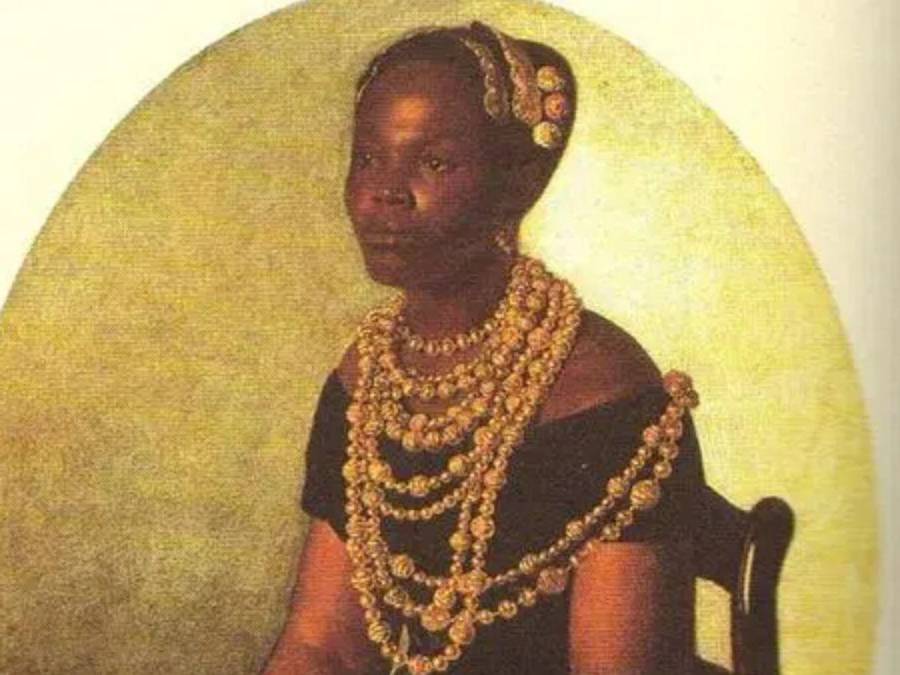 Portuguese, too hot and ‘not civilized’ enough. It was an adventure, not a home. Something that, in a patriarchal society, was definitely not meant for women.
Women were not there by choice. Black, enslaved, or freed, they would not be accepted in Portugal. Hence the frequent relationships between them and the Portuguese.
As was common at that time, Chica da Silva was the result of sexual abuse. During the period when slavery existed in Brazil, it was quite common for enslaved women to be sexually abused by their masters. The writer Ana Miranda, author of the book about Chica’s life, ‘Xica da Silva – The Black Cinderella’, claims that, as a consequence, enslaved women who became pregnant often aborted their children or resorted to infanticide because they did not want their children to be enslaved.
The fate of Chica da Silva, as she grew up, was nothing other than slavery. Her father did not free his daughter; on the contrary, years later, he sold her to a doctor, Manuel Pires Sardinha, who lived in Diamantina, then called Arraial do Tijuco.
Manuel Pires abused Chica da Silva, resulting in her pregnancy, and months later, the birth of Simão Pires Sardinha, who, freed by his father, received his assets in a will, and some historians claim that he held important positions.
Rise
When Chica was about 20 years old, she arrived in Diamantina. In 1753, João Fernandes de Oliveira, a diamond contractor (responsible for the exploration of the precious stone) and therefore a very wealthy man, bought Chica da Silva from her former owner for the sum of 800,000 réis. After being freed, she began to live with the contractor even without an official marriage. It was common at the time for slave owners to free their lovers – after years, not in two months, as in her case. Chica da Silva officially became known as Francisca da Silva de Oliveira. Until 1770, Chica and João Fernandes maintained a stable relationship that resulted in a total of 13 children, which kept Chica da Silva pregnant for much of her relationship with the diamond contractor.
Chica da Silva, a mulatto, frivolous, and overbearing, imposed herself in such a way that the rich Portuguese catered to all her whims. The greatest of them, as she did not know the sea, she asked her husband to build a dam, where she launched a ship with sails and masts, like the large vessels. It was this relationship that guaranteed the social rise of Chica da Silva and made her one of the richest and most important women in Colonial Brazil.
Chica da Silva lived in a magnificent house built on the slopes of the Serra de São Francisco, where she hosted balls and performances. Like every member of the wealthiest class in Minas Gerais, she owned numerous properties and many slaves, of whom few were freed. She only went to church richly dressed and adorned with jewels, followed by twelve companions. It is said that many people bowed to her as she passed and kissed her hands. She also participated in religious brotherhoods, as involvement with church activities was part of the social protocol for women of the time.
Regarding the children of Chica conceived in her relationship with João Fernandes, the four boys were educated in the city of Coimbra, Portugal. They were taken there by their father in 1770, the year the contractor had to return to his homeland due to the death of his father. This, in fact, marked the end of the relationship between Chica and João Fernandes.
The daughters of Chica and João Fernandes remained in Diamantina and were educated in the best institution in the region, which received the daughters of the mining elite. This was only possible because João Fernandes left enough resources to keep Chica and her daughters living quite comfortably.
Death
Chica da Silva died on February 15, 1796, and historians do not know the causes. Chica was buried in tomb number 16 in the Church of São Francisco de Assis, a place reserved only for white and wealthy individuals. This highlights the degree of social integration of Chica da Silva, although historians still point to certain limits regarding her social acceptance at the time.
The Myth of Xica da Silva
The story of Chica da Silva survived exclusively in oral culture for over 100 years. Until 1868, when the diamond lawyer Joaquim Felício dos Santos, who acted on behalf of her descendants, wrote about her in his Memoirs of the Diamond District of the Serro Frio comarca.
But this first incarnation of the myth of Xica da Silva was very different from what we know today. Thus, her author described her: “she had coarse features, was tall, corpulent, had a shaved head covered with a curled wig in hanging curls, as was then customary; she possessed no grace, no beauty, no spirit, had no education, in short, possessed no attraction that could justify a strong passion.”
According to historian Júnia Furtado, the author reconstructed the character according to the prevailing view of his time and projected his impressions onto the previous century. Joaquim Felício based his work on scenes from his social daily life, where women and families had to strictly follow Christian morality and where prejudices against ex-slaves, black women, and consensual unions — that is, born of passion, not of agreements between families — prevailed.
It was natural for him, in that context, to demonize the relationship between Chica and her partner, describing her as the embodiment of all negative stereotypes of black women: wicked, hypersexualized, manipulative, and authoritarian.
But the popular version, free from these moralizing traits, remained alive in the myth. In the 1950s, ‘In Romanceiro da Inconfidência’, Cecília Meireles wrote: “Not even Santa Ifigênia, all lit up in celebration, shines more than the black woman in her wealth. Behold, white ladies, on her balcony, Chica da Silva, the Chica-who-rules!”
The verses once again reinforce the traits of a strong-willed woman who invested in ostentation and had all her desires fulfilled by the diamond contractor.
More than a century later, Joaquim Felício’s great-nephew, João Felício dos Santos, revisited the story and wrote, in 1976, ‘Xica da Silva’, a novel that inspired the film by Cacá Diegues, made in the same year. According to Júnia, João Felício updates the myth and attributes characteristics more in line with the sexual liberation of the 1970s. Sexuality, instead of making her a monster, made her liberating.
From a legend of the city of Diamantina, Xica da Silva took the country. “Cinema democratized the myth, and the size of the screen was proportional to the dimensions it reached both in Brazil and abroad,” says Júnia Furtado.
The film even changed the spelling of the name and ensured that the figure of the ex-slave remained eternally associated with sensuality and beauty. It definitively broke the grotesque image that Joaquim Felício had composed and that historiography had not yet contested.
Not being tied to this tradition, and having the mission of captivating the viewer, cinema, by emphasizing the sensuality of the black woman, constructed a myth that fit the collective imagination of the time,” concludes the historian. The soap opera in the 1990s reinforced this image.
Exemplary Mother
From Joaquim Felício’s memories to the soap opera of the now-defunct Manchete, Chica da Silva has always been described as lascivious and dominant, an insatiable woman capable of dominating any man with the power of her body.
But let’s do a reality check here. The period of Chica’s life described in literature, cinema, or TV is the one she lived with João Fernandes, the diamond contractor. It was 17 years during which she had 13 children. In other words: she was pregnant for almost the entire relationship with João.
Documents from educational institutions attest to the care of Chica and João Fernandes with the formal education of their children. While the four boys attended school in childhood and continued their studies until university after going with their father to Portugal, the nine girls were interned at the Recolhimento de Nossa Senhora da Conceição de Monte Alegre de Macaúbas, the best educational institution in the captaincy, aimed at the mining elite.
After his departure, João Fernandes left Chica with enough assets for her and the daughters to live comfortably until the end of their days. There are no records of other romantic relationships of Chica.
Note here the story of an exemplary mother and housewife by the standards of the time.
And even being so dedicated, the insertion of this exemplary woman into white society was not as easy as in the movies. According to Júnia Furtado’s studies, the inequality of the relationship between Chica and João is evident in the baptism certificates of the children.
There, the names of godparents are socially unremarkable, which was not reasonable given the couple’s wealth. That is, no one wanted to commit to baptizing the mixed-race children. Furthermore, important documents to determine the inheritance of the former contractor omit Chica’s name in order to erase the African ancestry of the couple’s children.
Her trajectory reveals the attempt at whitening as a way to insert themselves more favorably into the prejudiced society that presented mechanisms of exclusion based on color, race, and birth condition. Money was Chica’s greatest ally. Because money has no color.
The Elephant in the Room
Xica da Silva, the myth, participated in the reaffirmation of another myth very dear to Brazilian nationalism — racial democracy. “The symbolic support of this nation myth goes through the selection of symbols that reinforce the belief in racial brotherhood, marked by a supposed equality in social relations.”
The representation of Chica da Silva, through Xica, was also part of the construction of the image of the black woman in Brazil. As Flávia explains, “she is our national matrix of black femininity and this aesthetic standard still marks the advertising imagination, for example.” According to the sociologist, the problem with the stereotype is that it creates reality and fixes images.
The attempt at whitening accompanied Chica’s descendants, and the fate of her children was paradoxical. There were occasions when the fortune they inherited, as well as the importance of their father and paternal ancestors, were decisive. At other times, the color they inherited from their mother weighed negatively.
João Fernandes de Oliveira Grijó, the firstborn son, was named the main heir of his father and received two-thirds of everything he left when he died. Money was never a problem. But as his father aimed to continue the process of making the family increasingly notable, the succession clauses prevented the heirs from marrying freely until they were thirty. They could only marry members of a higher nobility than themselves.
That was not what happened, as Grijó married at 28 to a farmer’s daughter. The marriage was authorized by the Portuguese government under two arguments: 1) that the bride was pregnant and it was necessary to restore her honor. 2) that, in his condition as a mixed-race person, it was practically impossible to achieve a marriage as required by his father.
As for the daughters, like their mother, they managed to marry young Portuguese men. The inheritance received from their father was sufficient to pay the dowries. Even so, some of them never legitimized their relationships.
Over the years, and very recently, Xica da Silva has been viewed as an exemplary story of what was supposedly unique and positive in Brazilian history. Her story showed that everything was possible in the land of racial democracy. Her sexual mystique spoke to a certain exotic romanticism, of mixed-race people as a kind of product of national terror. Of the carnavalesque figure of the “mulata”.
Throughout Brazilian history, this served as a racist distinction, asserting that someone was “less than black,” opening doors for social inclusion. In the case of women, this distinction also led to a certain fetish, celebrated in verse and prose. That there would be a superior sexual capacity in the mixed-race woman — sometimes shamelessly turned into a regional product, a tourist attraction of Brazil.
The new Chica, with “ch,” emerges from the revision of old ideas that Brazil had about itself.
The scientific production has been an important weapon against racial ideologies in Brazil. The more it advances, the more we know about the social processes that produce differences and racial inequalities in the formation of our nation.
Sources: www.ebiografia.com; mundoeducacao.uol.com.br; aventurasnahistoria.uol.com.br