



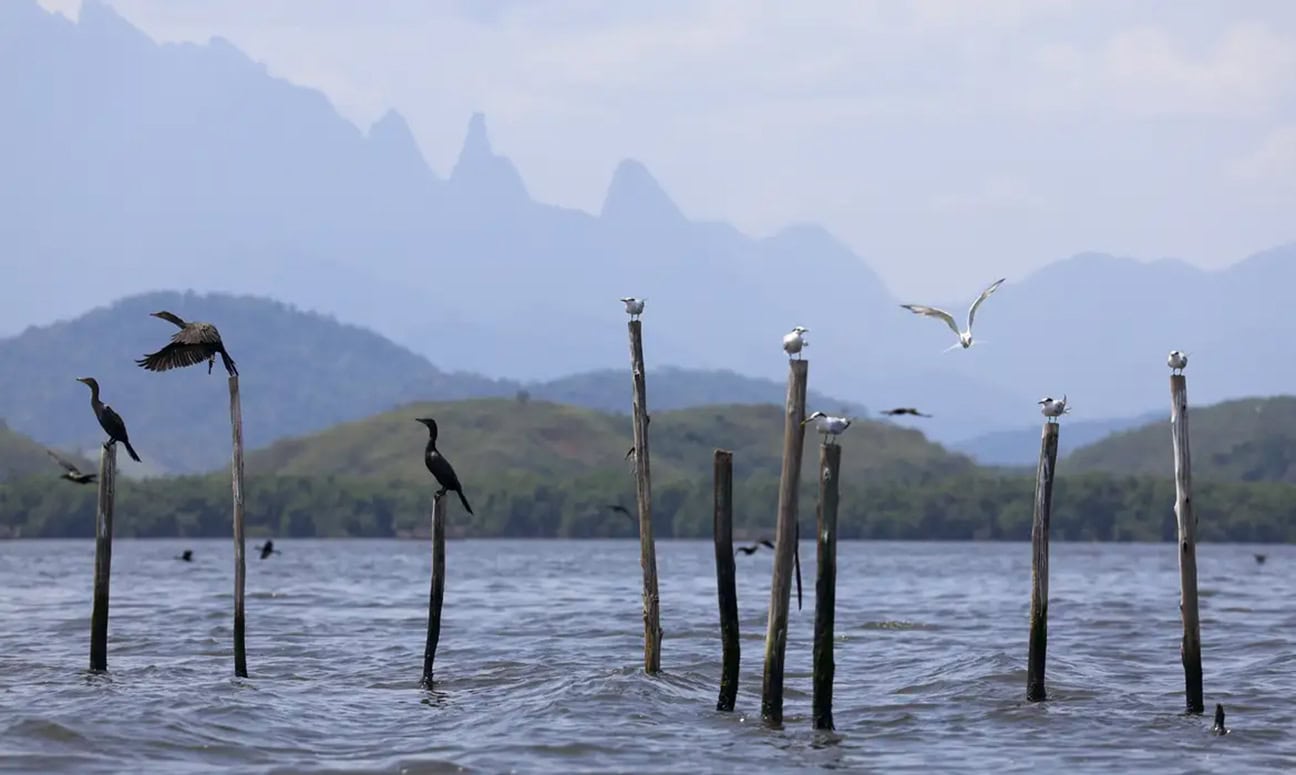
The Guanabara Bay, Rio de Janeiro, represents a paradox in popular imagination. On one side, it is associated with pollution; on the other, a postcard of Rio, bathing Sugarloaf Mountain, Paquetá Island, and with views of Corcovado, where the Christ the Redeemer statue stands, and Dedo de Deus in the Serra dos Órgãos National Park.
In the area known as the back of the bay, far from the Rio-Niterói Bridge, lie stretches of mangroves – an ecosystem considered muddy that transitions between marine and terrestrial environments.
It is common among the fishing boatmen to refer to the soil of the mangroves as substrate instead of mud, to reduce the existing stigma.
Artisanal fisherwoman Lucimar Machado, founder of the Projects Luthando pela Vida and Remando o Manguezal, shares the view that environmental tourism is a way to showcase the true beauty of the mangroves.
“We preserve and want people to come here and help us promote and preserve this environment because we live off this environment,” explains Lucimar.
Community-based tourism
According to Pedro Belga, founder and president of the non-governmental organization Guardians of the Sea, 650 families are registered as crab gatherers, an animal that lives in the mangroves. Those who depend on fishing number 5,000, with an average income of R$ 2,000 per month.
Lucimar describes the fishermen’s activity as “community-based tourism.” “We do kayak tours, taking people to see the catching of fish from the corrals (a trap made with bamboo), to see dolphins.”
“Sometimes I go to some events, and people say, ‘the back of the bay is rotten, all dirty.’ Then I say, ‘you just won a kayak tour to see it.’ People come wanting to prove that everything is dirty, and when they get here, they fall in love with the beauty of the place,” she says, who also sells handicrafts, such as earrings made from fish scales.
A statistic states that 83% of Brazilians know what mangroves are. However, 58% have never visited them.
 This information is part of the publication Ocean without Mysteries: blue carbon of mangroves, released by the Cazul project, linked to Guardians of the Sea.
The survey was launched during the 16th Conference on Biodiversity of the United Nations (COP 16) in Cali, Colombia. The scientific and environmental work is supported by the Boticário Group Foundation.
Restoration
Alaildo Malafaia is 62 years old. He has been working in fishing in Guanabara Bay for over 40 years. For the past 16 years, he has been involved with the Fluminense Mangrove Cooperative, which he presides over. The institution is a partner of Guardians of the Sea and works on the conservation and recovery of mangroves.
“When we plant mangroves, we are generating bioeconomy. When we do community-based tourism, we are generating bioeconomy. With handicrafts, we are generating bionomy,” he comments.
Oceanographer Liziane Alberti also praises the sustainable development initiative. “Mangroves are also valuable for the economy; for example, artisanal fishing and tourism are just some of the activities that benefit from the health of these ecosystems.”
Traditional knowledge
In addition to fishermen being a crucial part of the restoration work, the oceanographer adds the importance of the traditional knowledge of these communities.
“Traditional communities have a wealth of knowledge. They carry a very rich traditional knowledge that is very important. After all, they know exactly how the tide works and the periods when animals reproduce. So, it is very important to associate all scientific knowledge with traditional knowledge,” she said.
“Sometimes, when we manage to secure funding to take care of the mangrove, to do replanting, a cleanup, most companies bring in people from outside, and they don’t know the area. They get lost or do things that shouldn’t be done. We need to call local people because we are the ones who live in the mangrove. We know how to take care of it.”
As proof, Malafaia from the cooperative cites a technique created by local restorers that proved effective in conservation efforts.
“The other NGO we partnered with produced seedlings in a nursery. When we took them to the field, over 50% of those seedlings would die. In our expertise as fishermen, we started taking the plankton from under the mother plant, removing it from the shade and bringing it to the light, and they didn’t die,” he describes.
“Empirical knowledge is fundamental in the natural regeneration of the mangrove,” he says.
“I didn’t know that my fishing knowledge had monetary value.”
Value of the community
The unprecedented study by the Cazul project indicates that Brazilian mangroves have a potential of at least R$ 49 billion in the carbon credit market.
Pedro Belga argues that traditional knowledge about conservation and restoration should be taken into account when dividing resources raised by environmental compensation mechanisms, such as the carbon market.
“The knowledge of these peoples guides us. You combine scientific knowledge with popular knowledge,” he justifies. “They have the right to a share of this market too. Achieving that is a journey,” he assesses.
“When this market reaches this point, when these people can benefit from the value paid per hectare of preserved or conserved mangrove or forest, this market could invest money in socio-environmental projects within these communities. This is how this money will reach them,” he concludes.
“It’s still a dream, but if it becomes a reality, it will be all good, everyone wins,” believes Malafaia.
The protected area has existed for 40 years and is considered an interruption of a development belt that “suffocated” Guanabara Bay.
“The existence of the APA [Environmental Protection Area] prevents this deadly embrace because otherwise, all this area where the Guapimirim APA is located would also be urbanized, sealed with asphalt, tiles, and everything else,” he says.
Despite all the conservation efforts, the managers of the unit reinforce an appeal to all residents of the 17 municipalities that make up the hydrographic region of Guanabara Bay:
“Trash is a big problem here because we have many nearby cities; we are in a metropolitan area. Throwing trash in the rivers, on the ground, it all gets carried away by rainwater and ends up in the rivers, ultimately reaching Guanabara Bay,” reports environmental analyst from the Chico Mendes Institute for Biodiversity Conservation (ICMBio), Natália Ribeiro.
Source: Agência Brasil