



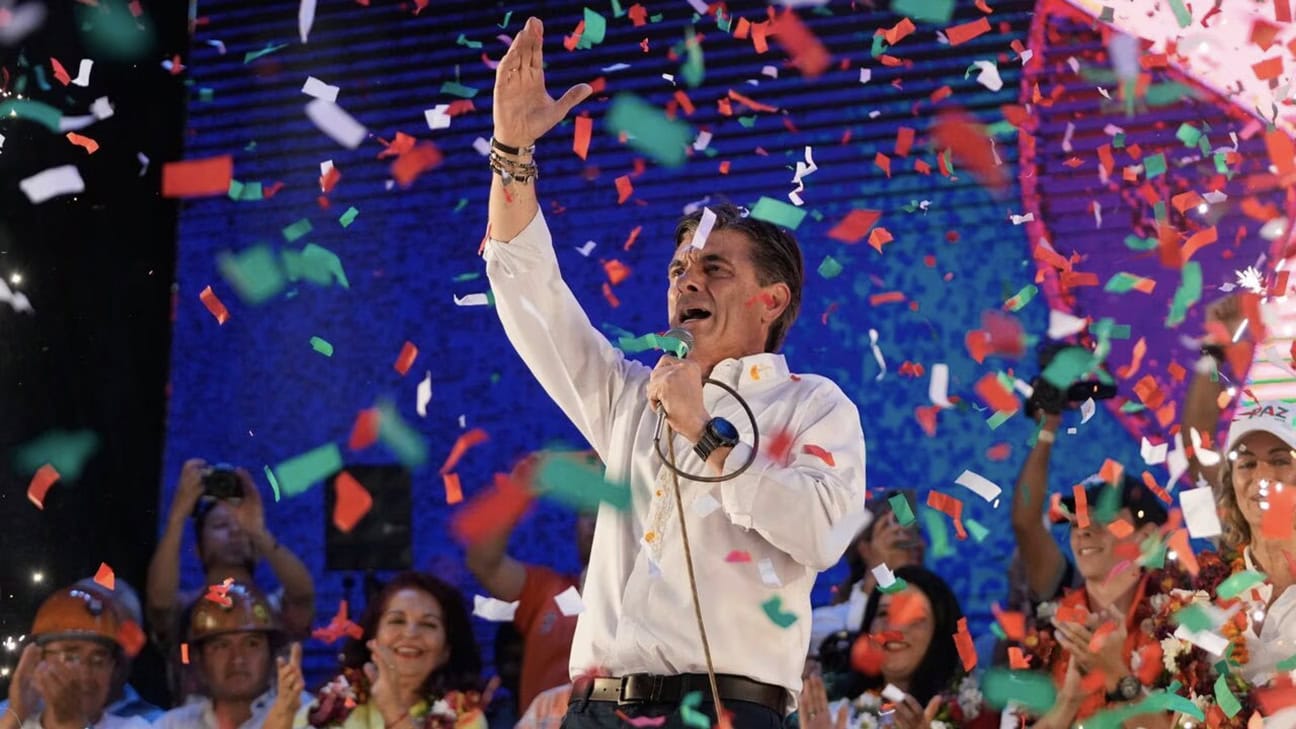
Center-right senator Rodrigo Paz was elected president of Bolivia after winning the second round of elections held on Sunday (19), defeating conservative Jorge “Tuto” Quiroga. The information was released by Agência Brasil based on official data from the Bolivian Electoral Tribunal and reports from Reuters and Telesur. Paz obtained 54.5% of the votes, against 45.5% for Quiroga, with 97% of the ballot boxes counted.
The victory ends nearly two decades of government by the Movement for Socialism (MAS), founded by Evo Morales, and consolidates a political transition amid the country’s worst economic crisis in years. Although elected president, Paz will not have a legislative majority, which will force him to form alliances to govern. His inauguration is scheduled for November 8.
Victory speech and promises of international opening
In his speech after the results were confirmed in La Paz, Rodrigo Paz stated: “We need to open Bolivia to the world,” signaling a clear change in Bolivian foreign policy after years of alignment with Russia and China. Quiroga quickly conceded defeat.
The new president also promised a balance between fiscal responsibility and social programs, advocating for an economy less dependent on the state. “We will try to build an economy for the people, in which the state is not the central axis,” he declared in an interview with Reuters before the election.
In late September, Paz revealed that he was negotiating a $1.5 billion economic cooperation agreement with U.S. authorities to ensure fuel supplies, representing a diplomatic realignment with Washington.
Political change after nearly 20 years of MAS
Rodrigo Paz’s election represents a significant change in the Bolivian political landscape. Since 2006, the country has been mainly governed by the MAS, supported by its indigenous base and policies that strongly expand the state’s economic influence. Paz’s campaign adopted a moderate stance, promising to preserve social gains while advocating incentives for the private sector and regional fiscal autonomy.
Jorge Quiroga, on the other hand, advocated austerity measures, public spending cuts, and dialogue with the IMF. Paz’s more gradualist proposal attracted left-wing voters dissatisfied with the MAS, without fully embracing the neoliberal agenda.
Trajectory marked by political legacy and controversies
Born in 1967 in Santiago de Compostela, Spain, while his family lived in exile, Rodrigo Paz is the son of former president Jaime Paz Zamora (1989-1993), who was accused of corruption and ties to drug trafficking but never convicted. At age 12, he survived a traumatic episode when his father was the sole survivor of an alleged air attack.
His political career includes serving as a deputy since 2002, as a councilor and mayor of Tarija from 2010 to 2020, a period marked by questions about overpricing and management failures. In the last five years, he has served as a senator for the Comunidade Cidadã alliance, led by Carlos Mesa.
Alliances, social media, and social challenges
Paz’s performance in the first round was boosted by his running mate, Edman Lara, a former police officer and popular figure on social media, especially TikTok, where he exposed corruption cases. Lara was expelled from the National Police in 2024 following a disciplinary process.
The new government will face resistance from social movements and unions. The Bolivian Workers’ Central (COB), the country’s main union, warned that it will react to any attempt to reverse labor and social gains. Indigenous organizations also signaled that they will begin a “new stage of resistance” to defend national sovereignty.
Economic challenges and governability in question
Without a majority in Congress, Rodrigo Paz will have to negotiate with various political forces to pass reforms. Bolivia faces high inflation, a decline in international reserves, and fuel shortages. Paz’s proposal includes tax incentives for small businesses, attracting foreign investment, and decentralizing resources to regional governments.
Experts warn that governability will depend on the new president’s ability to balance internal pressures, social demands, and the need for economic recovery.
Source: brasil247.com