



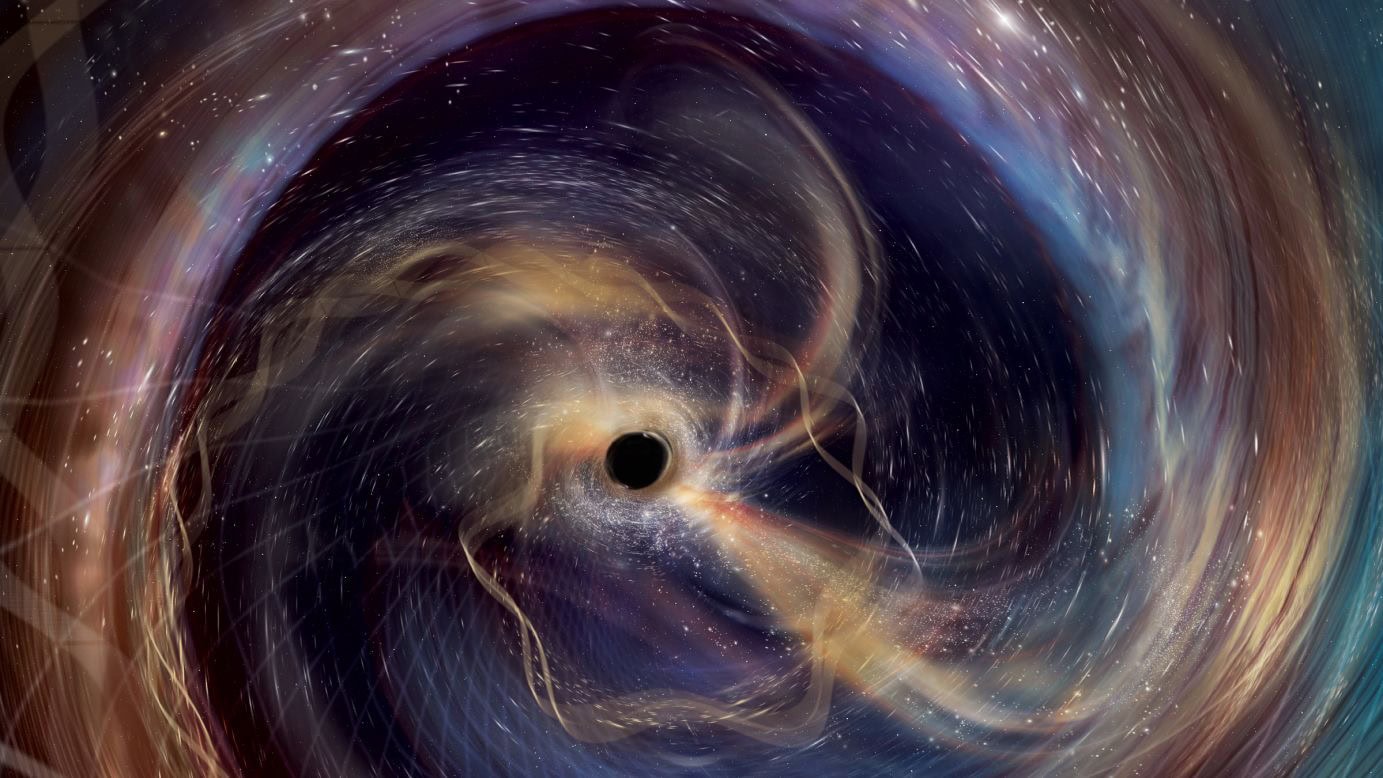
On September 14, 2015, physicists achieved the long-awaited goal of detecting gravitational waves, the shock waves expelled by cataclysmic events like the violent merger of two black holes.
This major breakthrough quickly earned the Nobel Prize in Physics for three of the leading figures in the effort. In the 10 years since then, scientists have detected hundreds of black holes merging, along with other extreme cosmic events like neutron stars colliding and black holes merging with a neutron star.
Now, in the journal Physical Review Letters, researchers claim that their ability to analyze gravitational waves has improved so much over the past decade that they were recently able to verify a key idea about black hole growth — an idea proposed by Stephen Hawking in 1971.
“There is a very famous statement in physics that Stephen Hawking developed, which is that the area, the surface area, of black holes can never decrease,” explains Maximiliano Isi, astrophysicist at Columbia University and the Flatiron Institute.
And he says that’s exactly what scientists observed after analyzing gravitational waves detected earlier this year. On January 14, detectors recorded gravitational waves that came from two black holes colliding about 1.3 billion light-years away.
Those black holes had masses 30 to 40 times that of our sun, so their collision was very similar to the one that led to the first gravitational wave detection in 2015. Since then, however, the pair of giant detectors operated by LIGO, in Louisiana and Washington state, have been repeatedly upgraded.
“Because the detectors are much better today, we can record the signal with much more clarity,” says Katerina Chatziioannou, gravitational wave physicist at Caltech.
This allowed them to perform a new analysis showing that, together, the initial black holes had a combined surface area of 240,000 square kilometers (about the size of Oregon). After merging to form a single black hole, its area was about 400,000 square kilometers (about the size of California).
Hawking’s theory says that the final black hole’s area has to be larger than the sum of the two initial areas, says Chatziioannou, “and that’s what we demonstrated observationally with this signal.”
This kind of proof is exactly what Hawking had hoped for a decade ago, when the first gravitational wave detection was announced. He actually contacted one of the scientists involved in that effort to see if gravitational waves could be used to test this prediction, says Isi.
At that time, however, it simply wasn’t possible because there was too much noise in the data and the analytical techniques hadn’t advanced enough.
Hawking died in 2018. “It’s unfortunate that Hawking is no longer here, but this is certainly a way his legacy lives on,” says Isi.
“All these ideas that people came up with in the 1970s, thinking it was just idle speculation, now manifest in real data,” adds Isi. “We see these things happening almost exactly as predicted.”
Albert Einstein, who predicted the existence of gravitational waves in 1916, thought they would never be detected. “If we told him we’re detecting gravitational waves from black holes colliding every two days, or every two or three days,” says Isi, “I’m sure it would have blown his mind.”
Overall, the researchers were surprised by the number of black hole mergers they saw, says gravitational wave researcher Gabriela González of Louisiana State University.
“We’ve seen so many black hole mergers. We’re learning so much about them that sometimes I feel like calling it ‘black hole astronomy’ instead of ‘gravitational wave astronomy,’” she says.
She would have predicted they would see many more neutron star mergers, but so far they’ve only seen a few examples of that.
That could change, as researchers are already working on plans for new, even larger gravitational wave detectors that would be 10 times more sensitive. “That’s our dream,” she says, adding that in another decade, those detectors could be under construction — maybe even completed.
Assuming the researchers secure the funding, of course. The current LIGO observatory, funded by the National Science Foundation, is facing possible budget cuts, with the Trump administration proposing sharp reductions in 2026.
Source: npr.org by Nell Greenfieldboyce