



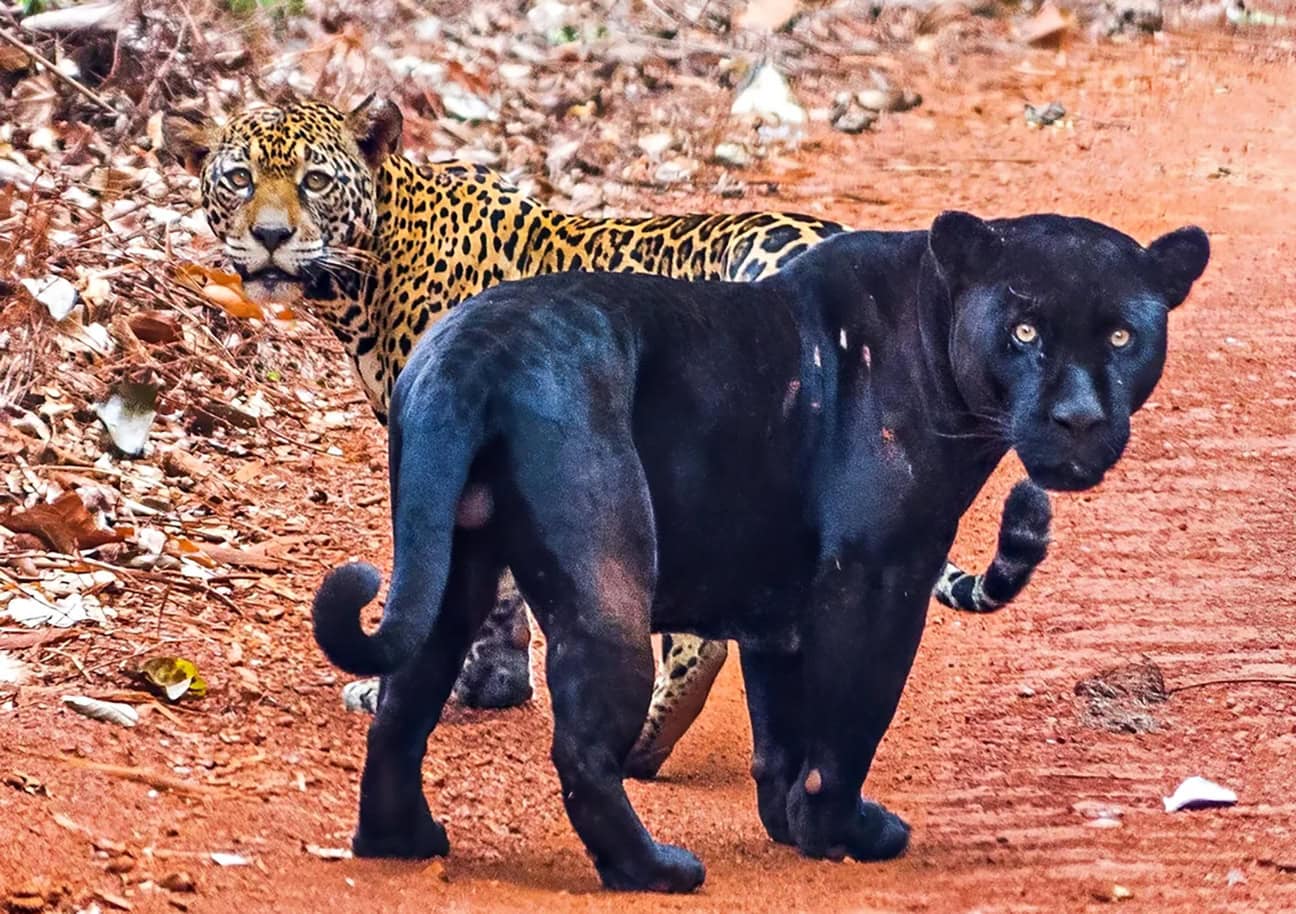
The presence of a black jaguar was recorded for the first time in the Reserva Particular do Patrimônio Natural Serra do Tombador, in Cavalcante, Goiás. The unprecedented images were captured by camera traps in March, April, and May of this year.
Also known as black panther, the melanistic jaguar (Panthera onca) has darker fur due to a genetic mutation that occurs in one in every ten individuals. The discovery is a positive sign of species preservation, classified as vulnerable by the Ministry of the Environment.
“Melanism is a genetic mutation that increases melanin production, making the animal’s fur dark-colored, but we know that for a melanistic jaguar to be born, at least one of the parents must also have this characteristic,” explained biologist Roberto Fusco, a member of the Rede de Especialistas em Conservação da Natureza.
The expert highlighted that the presence of jaguars is also an indicator of conservation of the area and its surroundings.
“Being an umbrella species that needs large territories to survive in the wild, protecting the jaguar has positive effects for many other species and the entire ecosystem,” observed Fusco.
Biologist Mariana Vasquez, manager of the Reserva Particular do Patrimônio Natural Serra do Tombador, stated that the records contribute to increasing the local community’s commitment to nature conservation.
“Without a doubt, these records of rare animals draw a lot of attention from those who live and work around the reserve, reinforcing the message that we all must strive to keep natural areas well conserved,” she argued.
Largest Felid
The jaguar is considered the largest felid in the Americas. In Brazil, jaguars are concentrated in the Amazon and the Pantanal. In the Pampa, it is considered extinct. In the other biomes – the Cerrado, the Caatinga, and the Atlantic Forest – populations are smaller and fragmented.
“The jaguar suffers from habitat loss mainly caused by deforestation, retaliatory hunting – motivated by possible attacks on domestic and farm animals – and also from the impacts of climate change,” added Fusco.
“Roadkill has also become a growing threat, especially in the Cerrado. It is a challenge that affects not only jaguars but many other wild animals that live in the biome,” completed Vasquez.
Jaguars are known for traveling long distances in search of food, shelter, protection, and places for reproduction.
“They are solitary animals that stay with their mothers until they are two years old. They can roam an area that can exceed 50,000 hectares,” pointed out Fusco. “Therefore, it is vital to strengthen conservation units and ensure the existence of ecological corridors, ensuring the conservation not only of jaguars but of several other wildlife species,” he stated.
Conservation Area
The Reserva Particular do Patrimônio Natural Serra do Tombador is a conservation area of 8,730 hectares. It is a Private Natural Heritage Reserve, created 20 years ago and maintained by the Fundação Grupo Boticário de Proteção à Natureza.
The unit is not open to the public but receives researchers. In total, 437 plant species and 531 animal species have been recorded in the reserve.
The reserve is considered a nature-based solution, as it contributes to protecting water resources, regulating the climate, and sequestering carbon in the soil. It also plays a complementary role in protecting the fauna of the Chapada dos Veadeiros region.
Source: Agência Brasil