



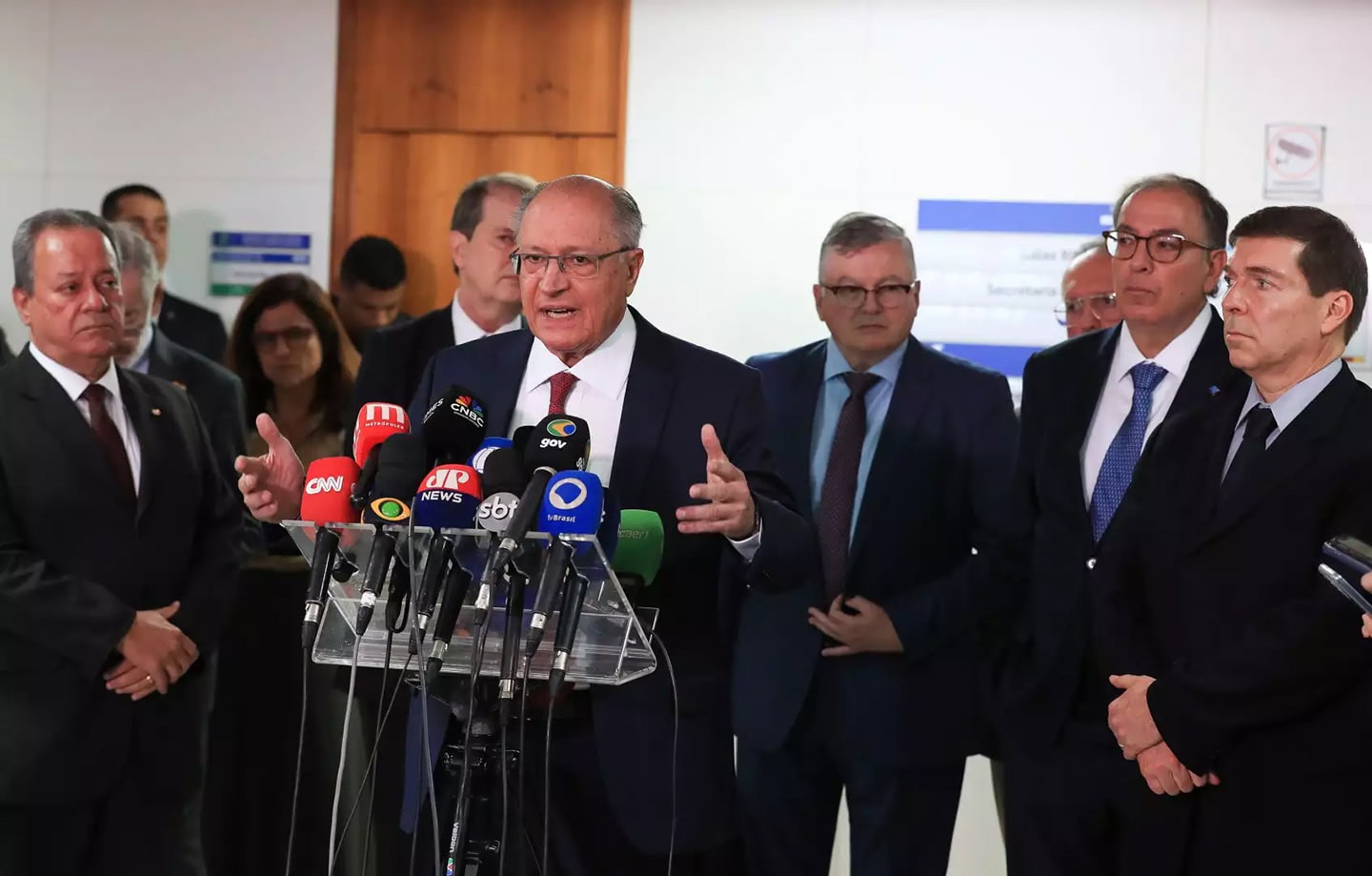
The federal government meets this Tuesday (15) with the industry and agribusiness sectors to discuss the 50% tariff imposed by the United States on Brazilian products. The first meeting with industry and agribusiness leaders will take place in the morning. In the afternoon, it will be the agribusiness sector’s turn.
Vice President and Minister of Development, Industry, and Commerce Geraldo Alckmin opened the morning meeting stating that the government will seek negotiations calmly, but without interfering in other branches of power, as Trump suggested when criticizing decisions of the Supreme Federal Court (STF).
Alckmin described the US measures as inadequate and called for cooperation from Brazilian business leaders.
“The participation of each of you, in your specific areas, is important so that we can work together. The Brazilian government is committed to resolving this issue, and we want to hear your suggestions,” emphasized the vice president.
The government will also speak with American companies that buy from Brazil and sell to the country. Alckmin noted that the tax raises costs and harms the economies of both countries, given the significant economic reciprocity in sectors like steel.
Committee
The dialogue with the private sector will be the first task of the newly created Interministerial Committee for Negotiation and Economic and Commercial Countermeasures.
The Ministries of Development, Industry, and Commerce (MDIC), Finance, Foreign Affairs, and the Civil House are part of this committee. Other agencies were invited to participate in the meetings.
On Monday, Geraldo Alckmin reinforced that Brazil was already in negotiations and awaiting a response from US representatives before the new tariffs were announced.
“On May 16, a negotiation proposal was submitted to the United States, albeit confidentially, but it has not yet received a response. And on Friday, before the announcement, a technical meeting was underway.”
Geraldo Alckmin highlighted the government’s full commitment to reviewing the tariff imposed by US President Donald Trump.
“The responsibility is for us to fully commit to addressing this issue. First, because it is completely inadequate. Brazil does not have a surplus with the United States—on the contrary. Of the ten products they export the most, eight have zero tariff. So, let’s work together with the private sector.”
The Brazilian government is still evaluating the measures it will take if the United States maintains the tariff, scheduled to take effect on August 1. The Economic Reciprocity Law, approved by Congress this year, is expected to guide the Brazilian government’s actions. The law’s regulation was published this Tuesday.
Source: Agência Brasil