



About 250 million years ago, our planet experienced what was probably the largest extinction event for life forms, known as the Great Dying. More than 95% of marine species and 70% of terrestrial vertebrate lineages are estimated to have disappeared during this period, which marks the end of the Paleozoic era and the beginning of the Mesozoic.
Dinosaurs are believed to have emerged and diversified a few million years after the extreme event.
A fossil discovered decades ago in Santa Cruz do Sul, in the Brazilian state of Rio Grande do Sul, and kept since then in the collection of the Federal University of Rio Grande do Sul (UFRGS), sheds new light on this moment in dinosaur evolution.
The description of the fossil – thought to belong to a new species called Itaguyra occulta – was written by Brazilian and Argentine paleontologists, based on two fossilized bones that were part of the animal’s pelvic girdle – an ilium and an ischium.
The study was published in Scientific Reports, one of Nature’s journals.
The scientists examined the morphology of the bones and discovered that the creature was a member of the silesaurid group (of the 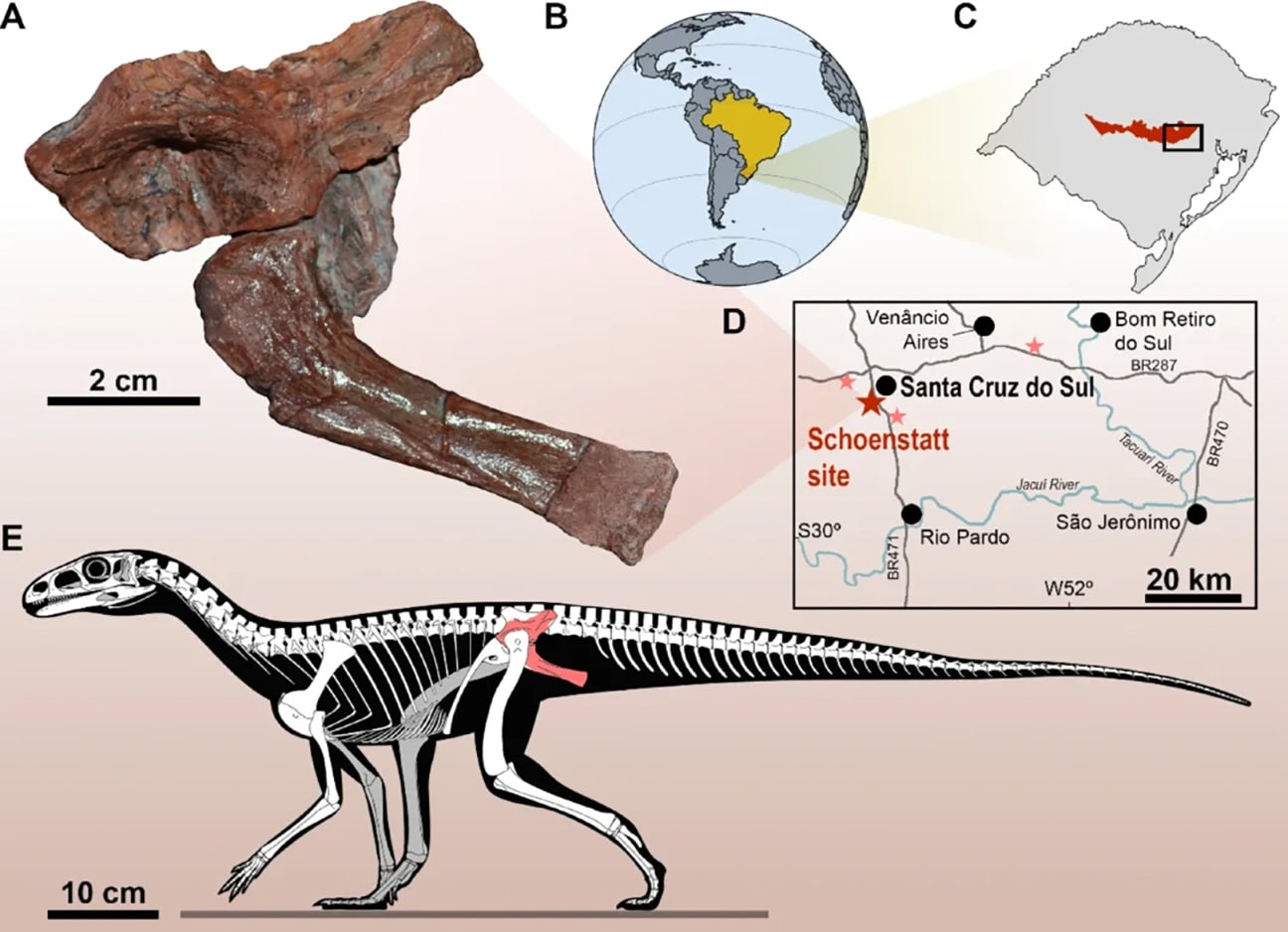 reptile clade) and not a cynodont (the clade to which mammals belong).
The study shows that the fossil is about 237 million years old – a poorly documented period for silesaurs – and indicates that this group of animals had a continuous presence in the territory of present-day South America during the Triassic.
Based on the study’s conclusions, the scientists argue that silesaurs are dinosaurs, more precisely members of the ornithischian lineage, and not just their close relatives.
According to Voltaire Paes Neto, a researcher at the National Museum of the Federal University of Rio de Janeiro and lead author of the study, “the discovery fills a critical time gap and supports the idea that silesaurs are not just close to dinosaurs, but may be the first representatives of ornithischians.”
“If this is confirmed, Itaguyra occulta will become one of the oldest dinosaurs in the world,” pointed out the paleontologist.
“The continuous presence of silesaurs in Brazil reinforces the role of the south of the country as a key territory for understanding the origin and diversification of dinosaurs,” said paleontologist Flávio A. Pretto, a researcher at the Federal University of Santa Maria (UFSM) and co-author of the study.
The new species is named in honor of the place of discovery. “Itaguyra” combines the Tupi words “ita” (“stone”) and “guyra” (“bird”). “Occulta” refers to the fact that the remains were hidden among other materials for decades.
Source: Agência Brasil