



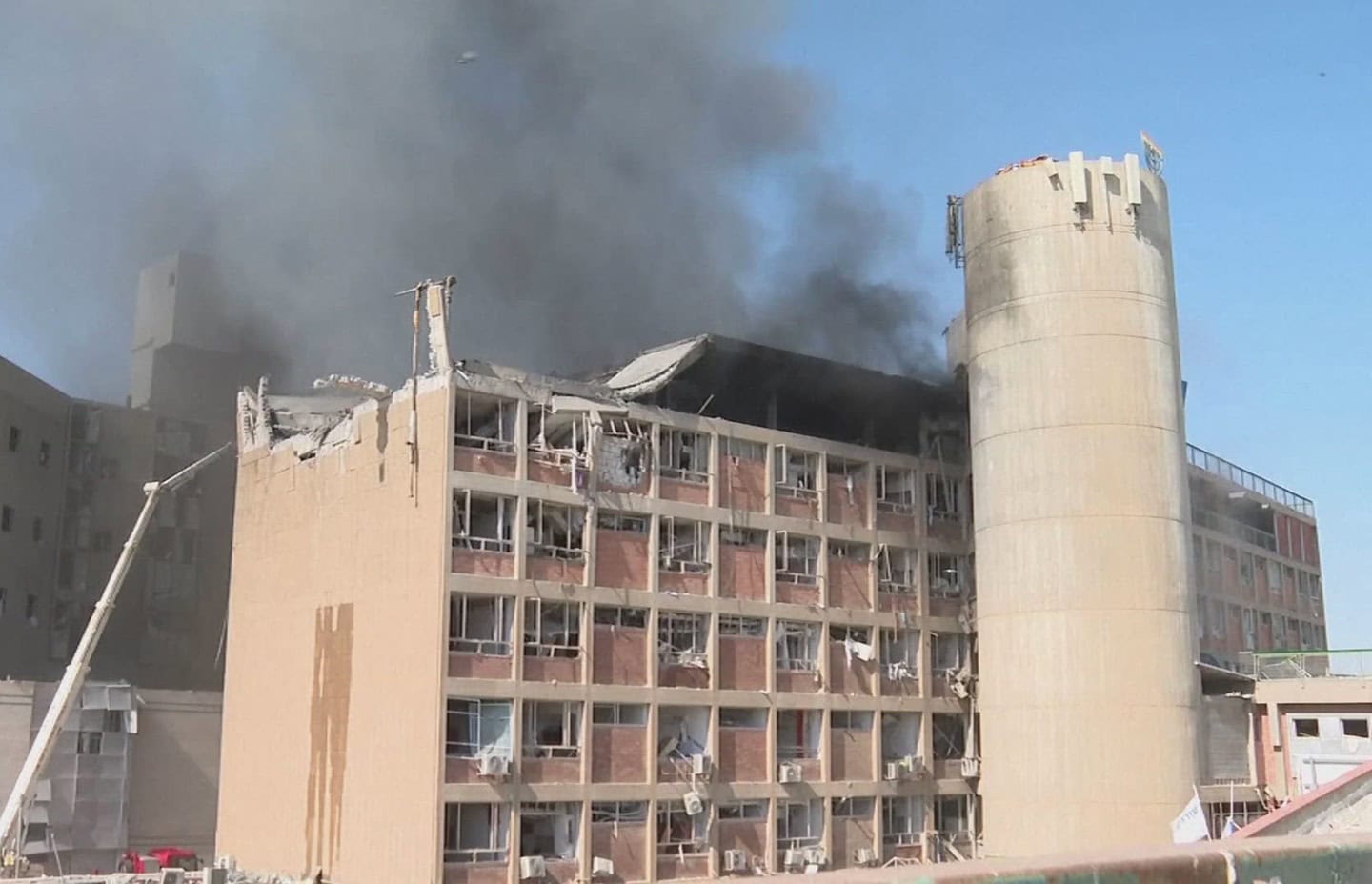
Several locations in Israel suffered direct impacts from Iranian missiles on Thursday (19), including a major hospital in the south of the country, prompting harsh warnings from Israeli leaders that they would intensify attacks against “strategic targets” in Iran.
According to a statement from Soroka Medical Center, the largest hospital in southern Israel, several people were being treated for minor injuries and shock cases. The attack caused extensive damage to the old surgical wing of the hospital, which had been preemptively evacuated several days earlier, according to the statement. Videos shared online showed destroyed hospital rooms and black smoke billowing from the facility.
Iranian state media claimed the missile was targeting a nearby military site and denied intentionally hitting the hospital.
Israeli Prime Minister Benjamin Netanyahu vowed retaliation for the attack.
“This morning, the terrorist tyrants of Iran launched missiles against Soroka Hospital in Beersheba and against the civilian population in the center of the country,” he said on social media. “We will exact the full price from the tyrants in Tehran.”
Israeli Defense Minister Israel Katz called the attack a “war crime” and said that Iran’s Supreme Leader, Ayatollah Ali Khamenei, “cannot continue to exist”.
Other missiles hit a tall building and other residential buildings near Tel Aviv.
Katz said that he and Netanyahu instructed the Israeli military to intensify its attacks against strategic and governmental targets in Tehran, as part of a broader effort to undermine the Iranian regime.
The Israeli military claims that more than 400 ballistic missiles and 1,000 drones have been launched against Israeli territory since the start of the conflict on Friday (13). Until Wednesday morning (18), Israeli authorities reported 24 dead and 838 injured, including 11 in serious condition and dozens more with moderate or minor injuries.
Israel’s emergency services, Magen David Adom, said that three people were in serious condition due to Thursday’s explosions, including an elderly person and two women. Another 42 civilians were injured by shrapnel or explosions, and 18 more were hurt while rushing to shelters.
Meanwhile, Israel’s attacks on Iran have killed more than 200 people, according to Iran’s Health Ministry. But an independent group called Human Rights Activists News Agency says it has counted 639 dead in Iran based on non-governmental sources.
Israel also continued its attacks on Iran overnight into Thursday, with the Israeli military saying it struck the Arak heavy water reactor. The International Atomic Energy Agency said the site — which it called the “Khondab (former Arak) heavy water research reactor” — “was not operational and did not contain nuclear material,” so there was no risk of “radiological effects”.
It was the latest action targeting Iran’s nuclear infrastructure since Israel launched its surprise attack seven days ago, as expectations grow that the United States may intervene militarily in Iran.
President Trump has so far refused to say whether the US would join Israel in attacking Iran’s nuclear sites.
“We are the only ones who have the capability to do it — but that doesn’t mean I’m going to do it,” he told reporters in the Oval Office after an unrelated event on Wednesday.
“I have ideas about what to do. I like to make the final decision one second before the deadline because things change, especially in war,” he said. Earlier in the week, he demanded Iran’s “unconditional surrender”.
Khamenei warned on Wednesday that any US military intervention would bring “irreversible consequences.” In a nationally televised speech, the Iranian leader said the nation would not surrender and would resist an “imposed war” in the same way it would resist an “imposed peace”.
Speaking on Thursday, Netanyahu said that the United States is “participating in the protection of the skies over Israel and its cities with THAAD missile batteries that are in Israel, with Aegis ships that are off Israel’s coast, with its pilots who are fighting alongside our pilots to shoot down drones”.
In an interview with NPR that day, Israeli President Isaac Herzog said the country would welcome interventions from “nations” — without naming the US — and “anything that helps to completely eradicate the Iranian nuclear program”.
As the fighting and rhetoric appear to escalate, some countries are calling for restraint. The foreign ministers of Germany, France, and the United Kingdom are set to meet with their Iranian counterpart in Geneva on Friday.
The three European countries played a role in negotiations over a 2015 nuclear deal with Iran. President Trump said the deal was too favorable to Iran and withdrew the United States during his first term.
“All parties must show restraint, refrain from taking steps that lead to further escalation in the region, and return to diplomacy,” the European countries said in a joint statement.
Source: npr.org By Rebecca Rosman