



A tombstone in a small blue chapel at the Araçá Cemetery in São Paulo affectionately mentions her: “An example for her family and for Brazilian democracy.” She lies next to several chapels belonging to Italian families, where the lawyer and one of the symbols of the fight against the Brazilian dictatorship and for the defense of human rights, Maria Lucrécia Eunice Facciolla Paiva, better known as Eunice Paiva (1929–2018), is buried.
Her story became even more famous after actress Fernanda Torres portrayed her in the film ‘I Am Still Here’, directed by Walter Salles. Nominated for Best Film, Best International Film, and Best Actress at this year’s Oscars, the film is an adaptation of the eponymous book written by Marcelo Rubens Paiva, Eunice’s son. In it, the author tells the true story of his family, centered on his mother’s struggle shortly after the disappearance of his father, Congressman Rubens Paiva, who was taken by police in 1971 during the military dictatorship in Brazil. Rubens Paiva’s body was never found.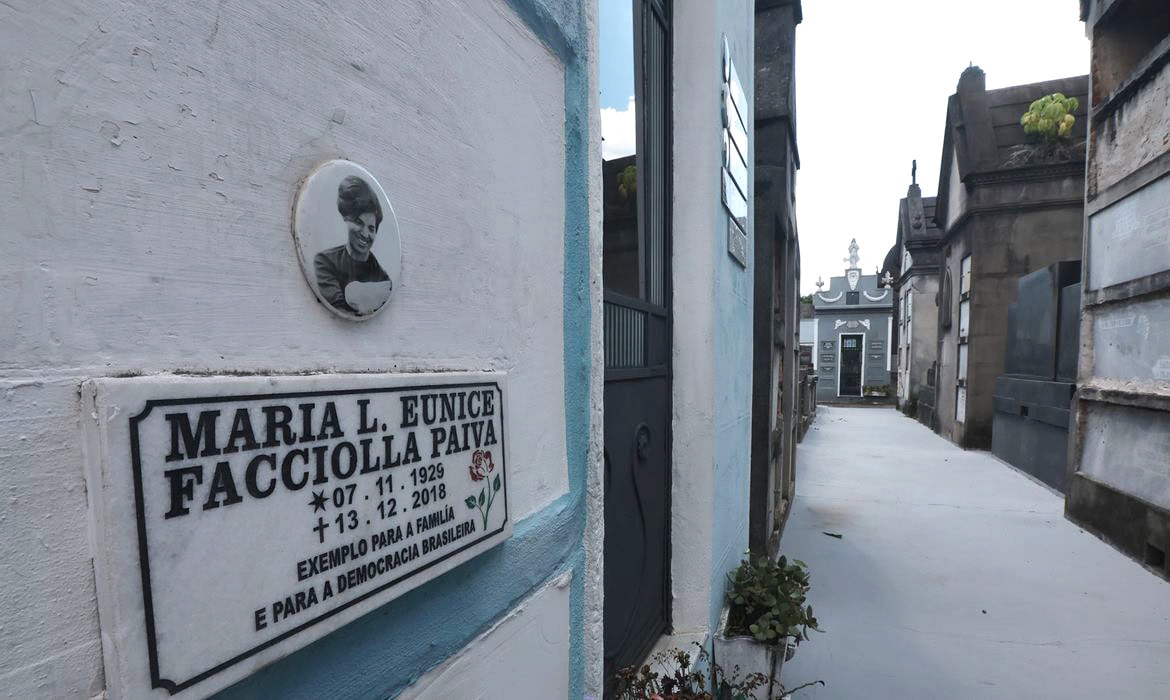 The success of the production sparked even more curiosity about her life and where she was buried, especially after actress Fernanda Torres, who won the Golden Globe for Best Actress for portraying Eunice Paiva in the film, visited the cemetery.
“The filming of ‘I Am Still Here’ ended a year ago, and I went alone to thank this great Brazilian for the honor of portraying her in the film. Thank you, Eunice,” the actress wrote last November, posting a photo next to the tombstone on her Instagram profile.
Tourist Attraction
Guided tours of the Araçá Cemetery — which now include a stop at Eunice Paiva’s grave — have attracted hundreds of visitors. The tours are part of the project ‘What Haunts You?’, which routinely promotes free visits to cemeteries and the graves of historical personalities throughout the state of São Paulo.
In addition to housing Eunice Paiva’s grave, Araçá Cemetery is also the resting place of other important figures in Brazilian history — such as actresses Cacilda Becker and businessman Assis Chateaubriand. It also houses the mausoleum of the Military Police and an ossuary where the remains of people murdered by the military dictatorship and buried in clandestine graves were once kept. The site is also notable for its artworks, created by artists such as Victor Brecheret.
Source: Agência Brasil