



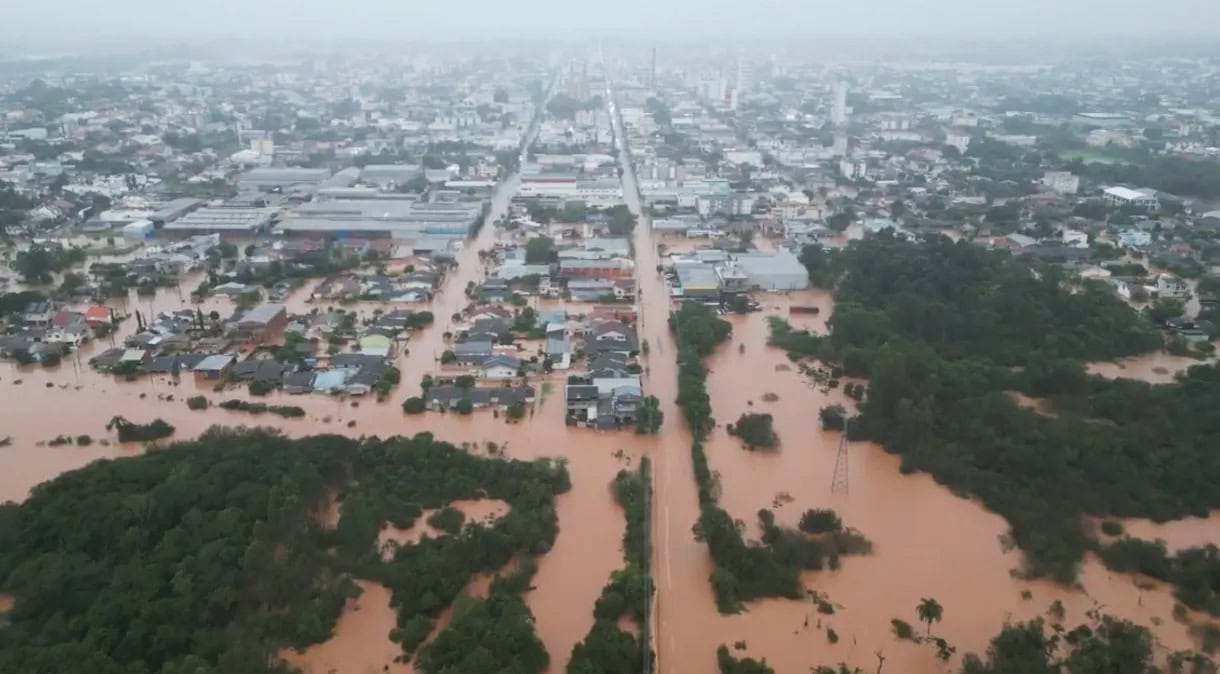
The death toll from a series of catastrophic floods in the Brazilian state of Rio Grande do Sul, in the south of the country, has risen to at least 83, the state Civil Defense reported on Monday (6).
Another 276 people were injured, at least 111 are missing, and at least 121,000 have been displaced, according to the Civil Defense of Rio Grande do Sul.
The disaster has affected more than 850,000 people in 345 municipalities, destroying homes, roads, and bridges.
Imminent Risk
The government of Rio Grande do Sul reported on Sunday (5) that the total number of dams at imminent risk of failure due to heavy rains has risen to six in the state. On Saturday, only two “required measures to preserve lives.”
In total, 18 dams in the state show some level of fragility. Besides the six dams in more critical conditions, another five are at “alert level,” when “anomalies require measures to ensure safety.”
There are also seven dams at “attention level,” when “anomalies do not compromise safety in the short term but require monitoring, control, or repair over time.”
How Did the Floods Start?
Rio Grande do Sul has increasingly been hit by extreme weather events in recent years, and at least 54 people died in the state in September after a subtropical cyclone.
The climate crisis, primarily caused by the burning of fossil fuels by humans, is intensifying extreme weather events worldwide, making many of them more intense and more frequent.
In Rio Grande do Sul, continuous and torrential rains began on April 27. One of the main reasons for so much rain in such a short time is the heat wave over the Midwest and Southeast of Brazil. This system is blocking the advance of cold fronts forming in the south and east of Argentina, keeping Rio Grande do Sul and Santa Catarina susceptible to instability areas responsible for so much rain.
Source: Agência Brasil and CNN