



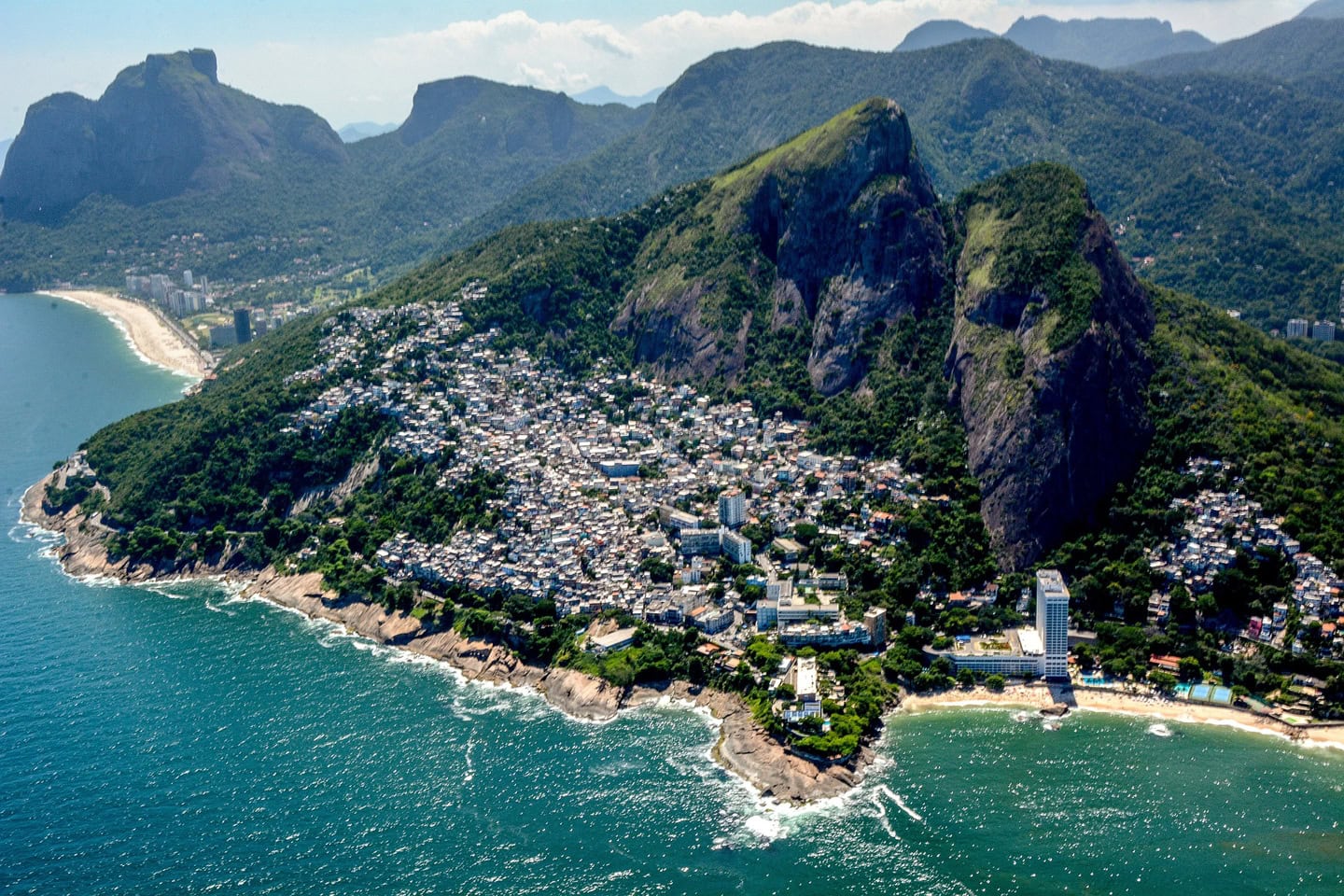
With elements that translate the best of the territories, Rio de Janeiro offers, in addition to traditional tourist attractions, a variety of cultural attractions in the favelas scattered throughout the city that you need to know. There are plenty of options for those who want to take a rolé like a native carioca, praising initiatives and inspiring stories that present different scenarios of the same place – the beloved Rio.
With the development potential already realized in the region, it is ideal that visits are made with the support of registered local guides, as well as associations or projects that welcome the public.
VIDIGAL
A cultural development hub, Vidigal is recognized for the social work that has taken thousands of young people to stages in theaters in Brazil and abroad. From the “Nós do Morro” project, names like Roberta Rodrigues, Thiago Martins, Marcello Mello Jr, and Jonathan Azevedo emerged. Not to mention visits from international stars like David Beckham, Kanye West, and Queen Latifah.
From the top of the favela, one of the most beautiful views can be appreciated. From the heights of VDG (the acronym for Vidigal), it is possible to see the beaches of Leblon, Ipanema, and Arpoador, in addition to the mesmerizing blue of the sea. Even those who are used to the place are enchanted by its beauty.
To reach the viewpoint, one can use a mototáxi or a circular van from the region. For those who want to extend their visit until the end of the day and enjoy the sunset, the tip is Bar da Laje – which has already become one of Rio’s favorites. There, you can find typical carioca snacks, drinks, and live music in an open and pleasant environment; Bar da Laje (@bardalage) is the right choice for the end of the day. More carioca than this, impossible!
It is also possible to visit Morro Dois Irmãos, Praia do Vidigal, and Parque Ecológico do Tiê. @parque_instituto_sitie.
For information about the place and guided tours: @favelatourvidigal.
SANTA MARTA
If you want a 360-degree view of Rio, the right choice is Santa Marta! The favela, located on Morro Santa Marta, shares space with the Botafogo neighborhood in the southern zone of the city.
From the colorful little houses that look like a painting, we see the statue of Christ the Redeemer up close, and on the other side of the community, we have Sugarloaf Mountain and Botafogo Beach, as well as the beautiful Lagoa Rodrigo de Freitas.
The favela has been in the collective imagination since 1996, when singer and songwriter Michael Jackson filmed scenes for the music video “They don’t care about us”! and all the alleys stopped for a day, putting the community on the world map. This feat earned a life-size sculpture of the King of Pop, created by sculptor Ique Woitschah in 2010. Since then, the place has become one of the most visited tourist attractions in the region, also visited by Madonna and Hugh Jackman.
For information about the place and guided tours: @saletetour/ @favelasantamartatour.
ROCINHA
It’s a World! For many years known as the largest favela in Latin America, Rocinha is in the minds of all cariocas and the Brazilian people. Due to its size, it has reached significant proportions in all spheres. Historically, the origin of its name comes from the old Fazenda Quebra-Cangalha, divided into small properties that used the space to sell products at the market in Praça Santos Dumont.
From “Rocinha” at the top of Gávea. In the thirties and forties, a motor racing circuit made the region the setting for what would be Formula 1 races. Isn’t that a rich history?
Jumping through time, the cultural attractions, the “Laje da Mulher Maracujá,” Porta do Céu, and Bar Mirante da Rocinha, where you can be enchanted by the famous Christ the Redeemer, Sugarloaf Mountain, and Lagoa Rodrigo de Freitas, as well as some neighborhoods in the southern zone of Rio de Janeiro, plus parts of Guanabara Bay – from a special angle. On the menu, contemporary cuisine and a list of refreshing drinks!
Discover the magic of Porta do Céu, in Rocinha
Among the alleys of Rocinha, a special place awaits you – Porta do Céu, a slab at the top of the hill offering a panoramic view, framing the beauty of the city of Rio de Janeiro. With a view of the stunning landscape, Porta do Céu presents us with a unique perspective of the marvelous city.
For information about the place and guided tours: @gilmarjuniorfernandes /@ocanjicatour /@pedroleo.tour
MORRO DA PROVIDÊNCIA
From the Gamboa neighborhood, located in the central zone of the city, Morro da Providência opens the paths of history, as it is the first favela in Brazil. Its first residents were ex-combatants of the War of Canudos, and at the time it was called “Morro da Providência.”
Among the slopes of the community, the most celebrated Brazilian author of all time, Joaquim Maria Machado de Assis, better known as Machado de Assis, was born. Author of the classics “Dom Casmurro” and “Memórias Póstumas de Brás Cubas,” the “Wizard” lived his childhood and adolescence among the alleys of the favela, a fact that was also essential for the cultural identity of samba, one of the richest symbols of the country.
With so many scenarios – some of them appearing in soap operas – Morro da Providência has a visual that needs no introduction, attracting even the attention of the greatest plastic artists in the world, the French JR, who along with Brazilian photographer Mauricio Horta created Casa Amarela, with services in education, art, and social support. The space mixes the experiences of residents with academia, aiming to stimulate the territorial value of the region. With a moon at the top, it is undoubtedly one of the easiest places to find. More than a physical space, it is a symbol of resilience and hope for the residents and for Rio.
For information about the place and guided tours: @ocosmeoficial
BABILÔNIA E CHAPÉU MANGUEIRA
Neighbors, the hills of Babilônia and Chapéu Mangueira are located in the Leme neighborhood, in the southern zone of Rio de Janeiro, and share the most beautiful nature that surrounds the entire city. Despite the short distance between them, both have characteristics that make them unique, each in its own way and space.
Chapéu Mangueira, for example, originated with the arrival of urban workers with strong activism during the years of dictatorship and the creation of residents’ associations. Babilônia appears on the list of favelas as one of the oldest, with a rural base and originally formed by residents from the North and Northeast regions of the country.
Respecting the diversity of their trajectories, both communities make Rio de Janeiro more plural and a meeting point, such as Bar do Davi, in Chapéu Mangueira, a space that welcomes visitors and residents alike. In the kitchen, the flavor of homemade food is the star, prepared with a seasoning that makes history due to the care with which it is made. In addition to the cuisine, the bar has also become a meeting point for local artists and live performances of Samba Circles and artists, always providing a pleasurable environment for visitors.
And if food is what unites us, the two communities give an example of how to make the most of all food. The Favela Orgânica initiative allows visitors to come into contact with a new approach to conscious consumption, alternative cuisine, home composting, and small-space gardens. The project, created by chef Regina Tchelly, has already brought workshops and lectures to several states in Brazil, as well as countries like France, Italy, and Uruguay.
For information about the place and guided tours: @amastourbabichapeu
FAVELA PEREIRA DA SILVA
A favela within a favela? It’s the artistic and playful form that comes from Favela Pereira da Silva, between the neighborhoods of Laranjeiras and Santa Teresa, located in the southern zone.
Popularly known as “Morro do Pereirão,” the current location of the community was once a farm in the 19th century. It started with a few families, and over the years, it has become a region that is now overcrowded.
To showcase the artistic richness of the place, the Morrinho Project was born, an open-air gallery that depicts local life and culture in colorful miniatures. With meticulous details, the scenery impresses and was created by talented young people who use scrap and recycled material to create true works of art.