



When you arrive in Jalapão, leave your cell phone at home. Pay close attention to the region’s nature and plan your activities. You won’t need to carry your phone with you. But there’s another good reason for this: there is no signal.
Located in a remote area of Tocantins, Jalapão is undoubtedly one of Brazil’s most incredible destinations, with stunning waterfalls, dunes, and wells, alongside maned wolves, marsh deer, and other regional wildlife.
Wonderful Waterfalls
The Jalapão State Park covers an area of 34,000 km², larger than the Brazilian states of Alagoas and Sergipe. To visit this paradise, you need to take a plane to Palmas, the capital of Tocantins, and then travel 190 km to Ponte Alta do Tocantins.
You can find travel agencies that organize tours. You can do the trip on your own, but it is much easier to hire one of these companies, which already have 4×4 vehicles to tackle the sandy terrain, as well as all the equipment used in the adventures and attractions.
In Ponte Alta, you will find some of the attractions for the first day: enchanting waterfalls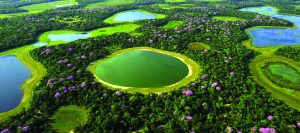
of the city. The famous waterfalls are: Fumaça, with its green water well, and Soninho, which has a natural pool great for swimming.
Dirt Road
Time to hit the road again! From Ponte Alta to the village of Mateiros, near the main attractions, it’s 160 km of dirt road.
However, there is so much to see along the way. The Sussuapara Canyon is small and easily accessible, but worth a visit for its beautiful view of rocks and vegetation.
The Velha Waterfall contrasts with the previous destination: large and impressive, it has so much water that locals call it the “Iguazu Falls of Jalapão.” You can swim and relax at the Prainha do Rio Novo on the way to the dunes, which are 40 meters high and resemble a desert. The place has an unforgettable sunset.
Quilombolas and Rafting
Another irresistible stop is the Fervedouro, a well where you cannot sink. The Fervedouro is surrounded by dense vegetation, full of banana trees and crystal-clear waters.
Next, head to the village of Mumbuca, where the quilombolas (descendants of Afro-Brazilian slaves who escaped from plantations until abolition in 1888) talk about their lifestyle and sell beautiful handicrafts made from golden grass, known as “gold of Jalapão.” Finally, arrive at the Formiga Waterfall, small but charming, with a large volume of water that forms a natural pool amid the local vegetation.
There is still much to do in Jalapão, such as rafting in the rapids of the Rio Novo and hiking on Morro do Espírito Santo, activities that take an entire day.
Source: Visitbrasil